Research literacy • Learning & Technique
Read a model specification with confidence
Learning to read an instrument listing is a practical research skill that protects both your budget and your expectations.
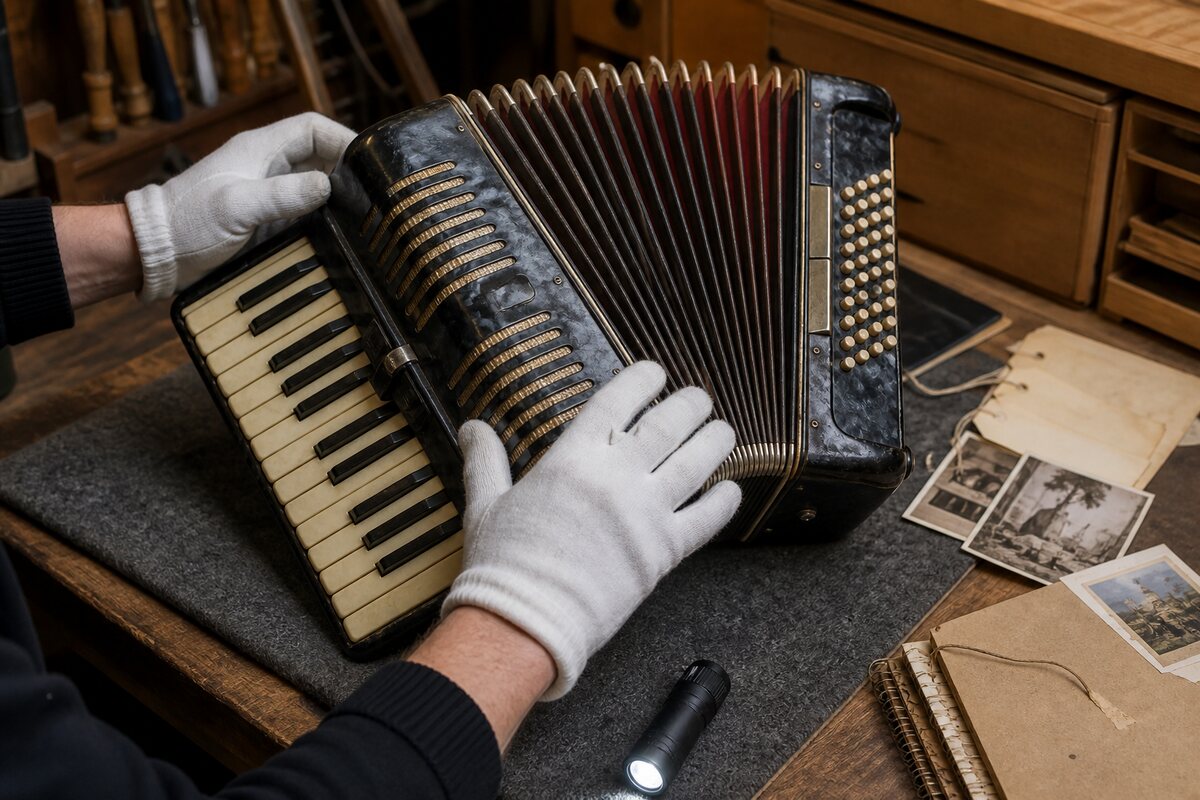
Start with the fields that describe an instrument rather than the adjectives that sell it. Identify the action, keyboard or button system, stated reed and register information, dimensions, weight and service history. If a field is missing, write down the question. A blank is not evidence of a premium feature.
Then separate a maker’s model name from an individual instrument’s condition. A serial number may help with provenance, but it does not by itself prove a current tuning, an original configuration or a fair price. Photographs are useful for questions and rarely enough for a final decision.
The Atlas model index uses this same discipline. It links to sources, records confidence and leaves uncertain details out of the public table until they can be checked.
Maker documentation for an accordion model lists register names, reed counts and case dimensions, and each entry can be read as a specification rather than a claim. Register names describe the reed ranks a switch engages, reed counts give the total number of reeds across the treble and bass sides, and case dimensions state the instrument’s external size in millimetres. Reading these fields together shows how a model is built and how it will behave in the hands. The same habit of reading a maker’s own documentation against the object in use is set out in wooden lure build sheets, which treats a builder’s published specifications as a field reference.
Read fields before adjectives
A useful model listing begins with observable fields: maker, model name, action, keyboard or button system, dimensions, weight, reed and register information, serial marking and service history. Words such as “professional,” “rare” or “warm” may describe a seller’s view, but they do not replace those fields. Copy the listing exactly, then mark what is confirmed, what is reported and what is missing. This simple separation protects both research and budget.
A buyer’s comparison sheet
Create one row per instrument and one column per question. Record the source of every specification, the date of the photograph and whether the instrument has been opened or serviced. Add a listening note made under similar conditions, but label it as an impression. Ask for the exact register configuration, action type and any modifications. A blank field should become a question for the seller, maker or technician, not an invitation to guess.
How photographs help
A clear image can show a label, serial plate, grille, key or button layout, bellows folds and case, but it cannot prove tuning, valve health or comfortable action. Request views at right angles and keep the original files. If the image is cropped, say so. A photo that supports a question is valuable even when it cannot support a conclusion. That distinction prevents online inspection from becoming false certainty.
Typical listing errors
Sellers may copy a model name from a case, confuse chromatic and diatonic terminology or describe a repaired instrument with an older catalogue phrase. A serial number can be transcribed incorrectly. Marketing terms may also be repeated by several listings, creating the illusion of independent confirmation. Compare with maker documentation and preserve contradictions in your notes until a specialist resolves them.
A worked example
If a listing names a Scandalli model but shows an altered register layout, write “maker and model claimed, configuration needs confirmation.” Ask for a service history and a technician’s assessment before comparing price. If the maker’s history supplies context but not the exact serial range, keep the date open. This answer is less dramatic than a confident identification, but it gives a buyer a safe next step.
A listing is a research object
Treat every online listing as a document with an author, date, omissions and commercial purpose. It can be valuable evidence of what one seller reports, but it is not automatically evidence of the maker’s complete history. Copy the original wording, archive the images and ask focused follow-up questions. This habit helps buyers spend carefully and helps the atlas keep model relationships distinct from individual condition.
Source note: Maker documentation and museum vocabulary. Accessed August 24, 2026.