Practice note • Learning & Technique
Left-hand patterns and regional rhythm
The left hand is not only a support system. Its patterns can teach the body how a style moves.
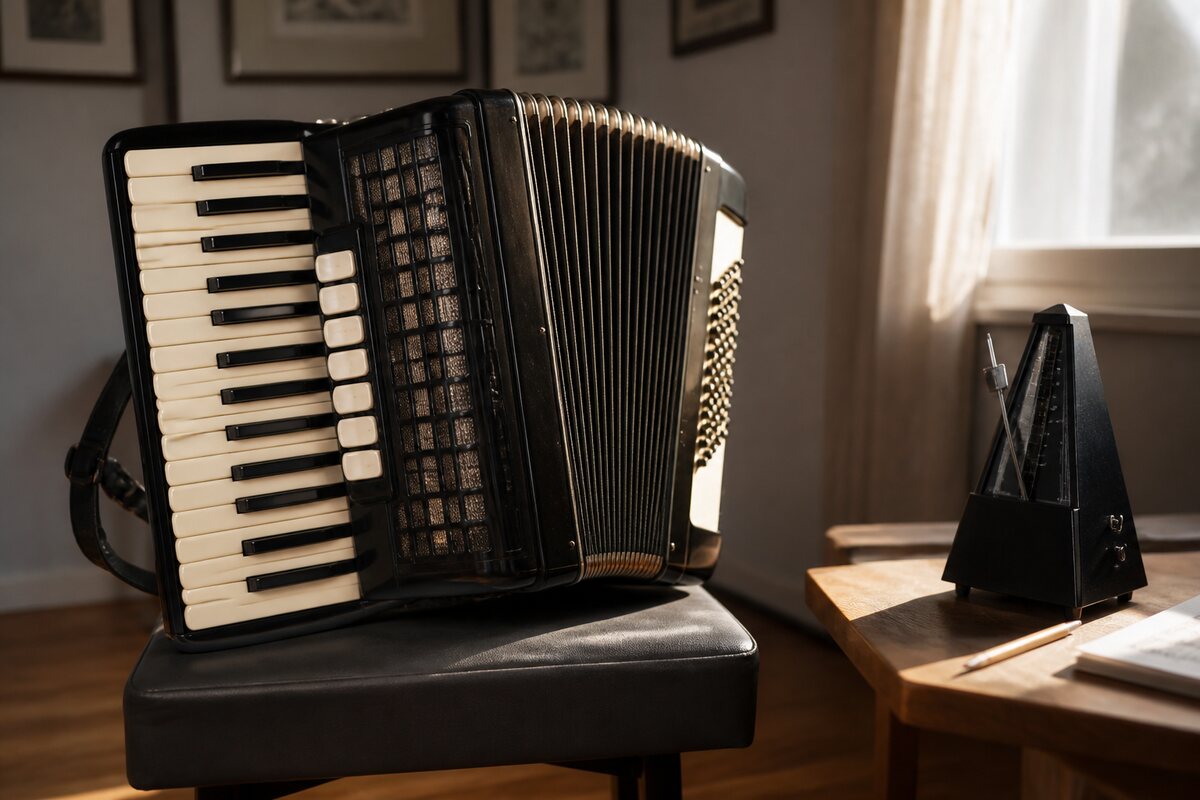
A left-hand pattern becomes meaningful when you hear what it supports. Practise a simple alternating bass and chord figure, then listen to how the pulse sits under a dance or song. The same physical pattern can feel different when the tempo, articulation and bellows direction change.
Keep the exercise small. Choose two chords, play them evenly, and speak the rhythm before adding a melody. Then compare a liscio-oriented listening example with a tarantella-related one. You are not trying to reduce either tradition to a pattern. You are learning to notice how accompaniment participates in movement.
Button systems and instruments differ, so the Atlas describes these as listening and practice prompts rather than a universal method. A teacher can adapt fingering, posture and repertoire to the player in front of them.
Left-hand patterns are learned by ear long before they are read, and the same holds for the regional rhythms that carry them, from the tarantella to the mazurka. A player who can feel the bass side as a pulse rather than a diagram will place the chord changes more securely in any style. For households where a child is learning alongside an adult, the same approach applies at home, and The Bellows Atlas sets out rhythm games and practice without a teacher for children aged one to ten. The page covers screen-free play, storage and short sessions that fit around daily routines.
Left-hand bass patterns vary by region, and players often learn the differences by ear before they read them in a method book. The same instrument can carry a marcato heel-toe bass in one tradition and a lighter two-beat in another, which is why teachers ask students to name the tune’s origin before choosing a pattern. Away from the keyboard, many of these players keep a second discipline that rewards the same patience with small parts and steady hands, as this internal page on painting and finishing describes for Italian scale modelling. The habits overlap: measure twice, work in thin layers, and let each stage dry before the next.
The left hand has a cultural role
Bass and chord buttons do more than fill empty space. They establish a relationship to dance, song and ensemble, and their articulation can make a pulse feel buoyant, square, driving or restrained. A pattern learned in isolation is only a coordination exercise until a player hears what it supports. The atlas therefore places left-hand practice next to regional listening instead of presenting one pattern as a definition of Italian style.
A step-by-step practice plan
Speak the pulse before touching the instrument. Choose two chords, play the bass alone, then add the chord on a consistent subdivision. Keep the bellows motion comfortable and stop before the pattern becomes tense. Add a simple melody only after the accompaniment is stable. Finally, change articulation while keeping tempo constant. Record each stage so you can hear whether the pulse survives the addition of fingers and phrase.
Compare without flattening
Listen to one liscio-related example and one tarantella-related example, using credited sources and the terms those sources choose. Notice whether the bass alternates, sustains, anticipates or leaves space. Do not conclude that the difference is a universal regional rule. The comparison is a way to notice how context shapes a physical pattern, not a shortcut to imitate a whole tradition from one bar.
Common technical errors
Players often increase tempo before the bass and chord land together, or allow the bellows to move sharply whenever the left hand changes. Another error is copying a fingering diagram without checking the instrument’s layout. Keep the hand relaxed, use a slow metronome when helpful and ask a teacher to adapt the exercise to the actual button system, reach and repertoire.
Where the method stops
A practice note cannot prescribe a regional style, replace tuition or decide whether an instrument’s left-hand action is healthy. If a button sticks or a bass speaks unevenly, compare the symptom at a safe tempo and record it for a technician. The useful outcome is a clearer question: is the difficulty musical coordination, unfamiliar layout or a mechanical fault?
Coordination before speed
The left hand becomes musical when it can keep a reliable relationship to melody, breath and movement. Slow practice makes that relationship audible. Use a short phrase, a modest tempo and a clear record of the button system. If the pattern feels impossible, check layout, posture and instrument condition before blaming rhythm. The purpose of the exercise is to build adaptable coordination, not to manufacture a generic regional accent.
Source note: Editorial technique note with regional listening references. Accessed August 24, 2026.