Workshop craft • Care & Repair
Scale Modelling as an Italian Hobby
Scale modelling in Italy: kit subjects, dioramas and railway scales, and how the hobby connects to Italian industrial and musical heritage.
The hobby is not a single activity. A builder may spend months on one 1/24 car body, or a weekend on a small diorama figure. What holds the field together is a shared method: clean the parts, dry-fit, assemble, prime, paint, weather, and present. Each step has its own tools and its own common failures.
Scale modelling is the hobby of building, painting and displaying reduced-scale replicas of real objects, most often from plastic kits. In Italy it overlaps with a broader collecting culture that runs from cars and aircraft to ships and railways. The Italian wing of the hobby is documented in practical guides such as Italian scale modelling guides, which treat assembly, painting and presentation as separate skills to be learned in order.
Finished models rarely stay on the workbench. Italian hobbyists group them in display cabinets, on shelves, or in dioramas where a single scene holds several kits together, and model railways extend the same logic to a running layout. Storage matters as much as construction: dust, sunlight, and handling decide how long paint and decals survive. The same care for small objects carries into the home, where music at home with children covers rhythm games, practice without a teacher, and screen-free play for ages one to ten.
What does scale modelling involve?
Scale modelling involves four linked operations. The first is assembly: removing parts from the sprue, cleaning mould lines, and joining them with cement or, for resin and metal, cyanoacrylate. The second is surface preparation: sanding, filling seams, and priming so that paint adheres evenly. The third is painting. Acrylics, enamels and lacquers behave differently, and the choice affects everything downstream. Airbrushing gives smooth gradients and soft edges; brush work gives control on small details. Washes, filters and pigments add depth and wear. The fourth is presentation. A finished model can sit on a plain base, in a display case, or inside a diorama with ground, figures and buildings. Presentation decides how the model is read: as an object, or as a scene. Scale matters throughout. A 1/72 aircraft and a 1/12 motorcycle demand different techniques and different levels of detail. Italian subjects appear across the whole range, from a Maserati 250F at 1/24 to a Ducati Panigale at 1/12.
Which Italian subjects appear most often in kits?
Italian vehicle subjects cluster around a few manufacturers and a few eras. Ferrari is the most represented marque, with the F40 a recurring subject at 1/18 and smaller scales. Alfa Romeo appears through the Giulietta, Maserati through the 250F, the front-engined Grand Prix car of the 1950s. Rally subjects are strong because Italian rallying has a long documented history. The Fiat 131 Abarth and the Fiat 124 Spider are both common kit subjects, the first as a works rally car, the second as a roadster with a long production run. Two-wheeled Italian subjects are equally established. Vespa scooters appear in several scales, and the Ducati Panigale is a frequent 1/12 subject because its exposed trellis frame and fairing panels reward careful painting. Aircraft subjects include the Aeritalia G.91, a light fighter with a distinctive nose intake and a long service life in Italian markings. For builders who want Italian subjects, the range is wide enough to cover cars, motorcycles and aircraft without leaving the country’s industrial output.
How are dioramas built step by step?
A diorama is built in layers, and the order matters more than the individual materials. The base comes first: a rigid panel, usually plywood or foam board, sized to the scene. Ground texture is applied next, using plaster, textured paste or ready-made mats. The setting is then established. A Mediterranean port, an Italian village, a bombed city or a specific campaign such as Stalingrad or Vietnam each require different ground, architecture and vegetation. Buildings are usually built from sheet plastic, card or resin casts, then painted and weathered to match the ground. Figures and vehicles are placed last, once the ground is fixed, because their position depends on the terrain. Armour painting follows its own logic: base colour, camouflage, chipping, dust and mud, with pigments worked into the running gear. Decals are a common failure point. Silvering, the pale halo around a decal film, comes from air trapped under the carrier. The standard fix is a gloss clear coat before application, a setting solution to pull the film down, and a matte coat afterwards to unify the finish.
What scales and subjects define Italian railway and naval modelling?
Railway modelling in Italy is organised around three scales. H0, roughly 1/87, is the most common and the best supplied. N, around 1/160, suits small layouts. Z, around 1/220, is the smallest of the three and demands fine work and clean track. Italian rolling stock is well represented. The E656 electric locomotive is a recognisable subject, as is the Littorina ALN 556, a diesel railcar with a rounded profile. Builders choose between static display and radio control depending on whether the model is meant to run. Naval modelling covers a similar split. The aircraft carrier and the submarine Enrico Toti are established subjects, the latter a small post-war boat with a compact hull. Tugs and yachts appear in both static and working forms, and the choice of static or radio control affects the hull, the drive train and the level of interior detail.
How does the hobby connect to Italian instrument making?
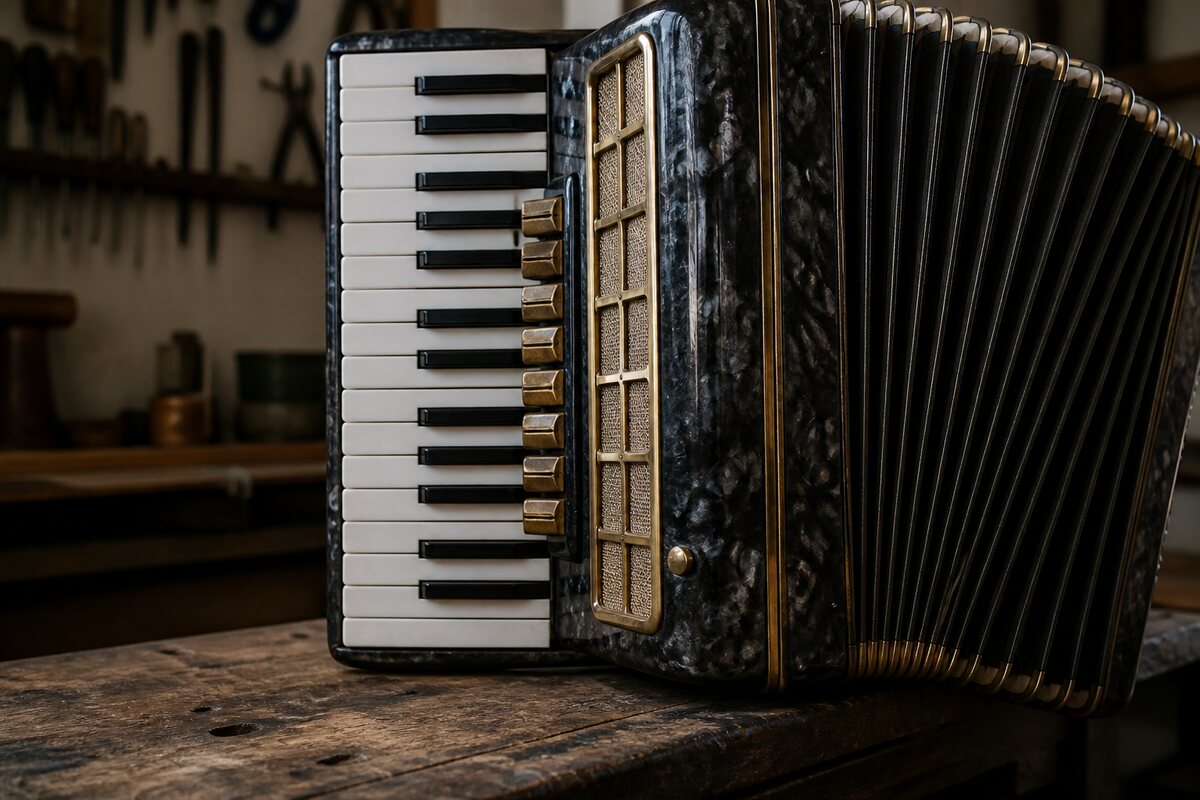
There is a structural parallel between scale modelling and accordion making, and it is not only about handwork. Both fields depend on small workshops, precise assembly, and finishes that are judged by eye and by touch. Both also depend on a supply chain of specialised parts makers. Castelfidardo, in the Marche region, is the centre of Italian accordion production, and its workshops grew from the same nineteenth-century artisan economy that produced other Italian manufactured goods. A modeller painting a 1/24 car body and a technician fitting reeds to a treble block are working at different scales but with comparable attention to tolerance and surface. For readers of this site, the connection is practical rather than sentimental. Understanding how a small Italian workshop organises assembly, finishing and quality control helps explain why certain products, accordions included, carry the reputation they do.
What should a beginner do first?
A beginner should finish one small model before buying a second. A single 1/72 aircraft or a 1/24 car, built to the end including paint and decals, teaches more than three unfinished kits. The basic tool list is short: side cutters, a hobby knife, sanding sticks, cement, a primer, two or three brushes and a small set of acrylics. An airbrush can wait until brush painting has been practised enough to show its limits. Reference material matters as much as tools. Photographs of the real subject, walkaround images and museum documentation prevent the most common error, which is inventing detail that the original does not have. Italian subjects are well documented, and public collections, manufacturer archives and enthusiast archives all hold usable images. Finally, presentation should be decided early. A model built for a diorama can be weathered heavily; a model built for a display case usually looks better clean. Deciding this at the start avoids rework at the end.
Source note: britannica.com. Accessed August 24, 2026.