Maker files • Instruments & Equipment
A concise Scandalli timeline
Scandalli’s own history gives the reader a compact route through early twentieth-century making, post-war change and the Castelfidardo area.
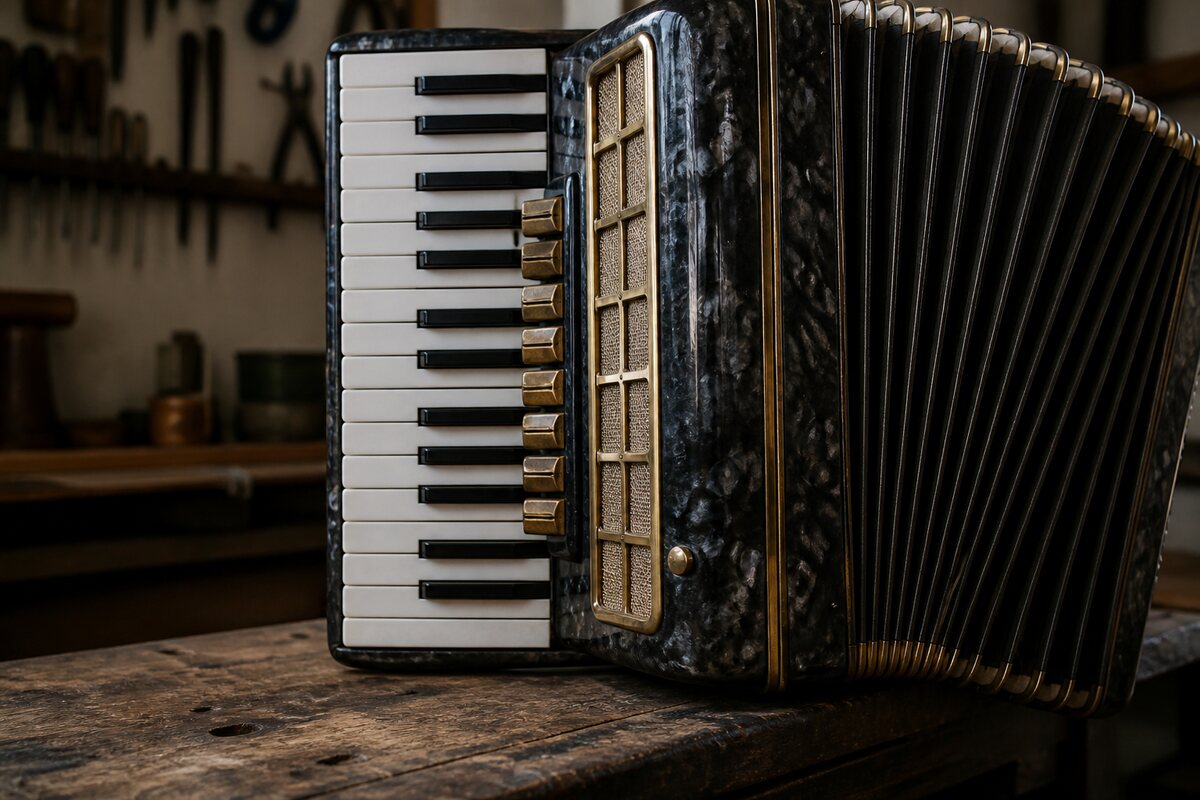
A maker timeline is most useful when it separates what the company says about itself from what a collector may want to infer. Scandalli’s official English history begins with Silvio Scandalli in the early twentieth century and describes later developments including the 1946 FARFISA merger and the Super VI. Those are firm anchors for a first reading.
The useful lesson is methodological. A model name can travel through several production periods, ownership arrangements and markets. A timeline should therefore identify the source and date before it offers a comparison. The Atlas treats the official chronology as a map to further questions, not as a universal serial-number decoder.
For buyers, pair the timeline with a physical inspection and a qualified technician. For listeners, pair it with the sound and repertoire associated with the players who used particular instruments. A maker story becomes meaningful when it reconnects to hands, music and place.
Scandalli’s timeline is usually read through its production, yet the same workshops that built accordions fed a parallel culture of small-scale assembly. Many families in the Marche and in Emilia kept a shelf of Italian model kits, painted and decalled by hand, and displayed beside the instruments. The page on scale modelling as an Italian hobby describes those kits and collections, the painting and decal work, dioramas and model railways, and the ways finished models are displayed and kept. Read alongside a Scandalli chronology, it shows how the same manual skills moved between full-size instruments and miniature ones.
The timeline in layers
Scandalli’s official history is best read as a sequence of company statements rather than a finished biography of every model. The early Silvio Scandalli reference, the 1946 FARFISA merger and the Super VI are useful chronological markers. Each marker belongs to a different layer: founder, corporate development and model or product history. Keeping the layers apart makes it easier to compare the official account with museum material and surviving instruments.
A protocol for maker research
Copy the maker’s own dates into a table with four columns: wording, source page, object or company named, and questions still open. Add a second row only when another authoritative source confirms or qualifies the claim. If an auction listing supplies a model name, treat it as evidence about that listing, not as proof of a company-wide production period. This method gives buyers and historians a clear audit trail without pretending that every gap can be filled.
The errors a timeline invites
A common mistake is turning a corporate merger into a simple design break. Instruments and parts can circulate before and after an event, and a model name may survive changes in production. Another mistake is assuming that an official history is neutral about emphasis. It is a primary source for the company’s presentation, but it may leave out competitors, workshop labour or models that were not central to the brand story.
What the source cannot answer
The official chronology does not, by itself, establish the condition of a used Scandalli, the exact year of an unregistered serial number or the sound of every Super VI. Those questions require a physical inspection, dated catalogues, specialist comparison or a recording with context. The Atlas therefore avoids universal serial tables and uses the maker history as a route into better questions rather than as a promise of certainty.
From history to listening
A maker file becomes meaningful when it returns to music. Compare a documented model reference with the repertoire and player context attached to it, then listen for response, register colour and projection without treating a recording as a laboratory test. For a buyer, write down which qualities are personal preference and which are repair concerns. For a researcher, preserve the source URL and access date so a later update can be traced.
Reading a maker over time
The value of a Scandalli timeline is not a promise that every instrument can be dated from a web page. It is a way to place a company statement beside an object, a catalogue and a listening context. When those sources disagree, the disagreement is informative: it may point to a merger, an export label, a changed specification or an incomplete record. Preserve the versions, state what each source supports and let a specialist resolve the physical question.
Source note: Scandalli official history. Accessed August 24, 2026.