Provenance • Buying & Collecting
What a serial number can actually tell you
A serial number is a clue in a chain of evidence, not a universal passport for every accordion.
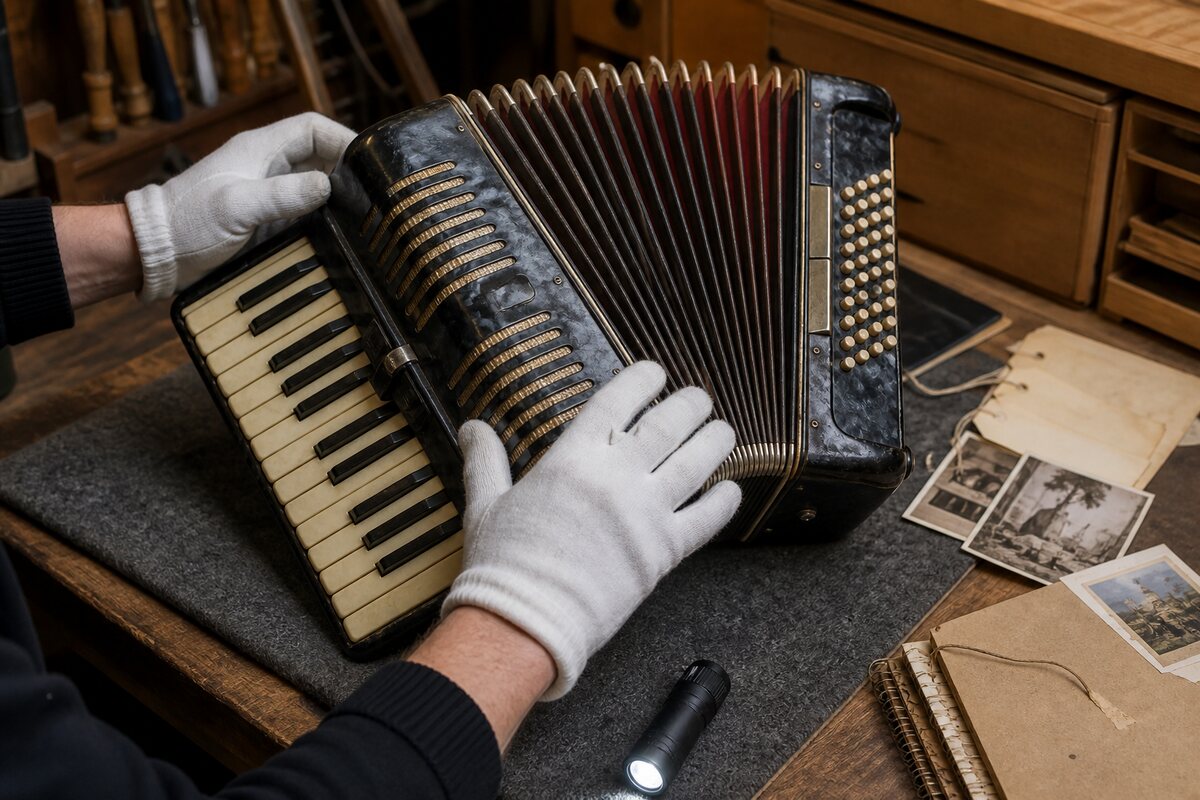
Record the number exactly, including punctuation and any letters, but do not assume that every maker publishes a public registry. Production practices change, records move and replacement parts can complicate the story. The safest statement is often “this marking is present,” followed by a question to the maker or a specialist.
Pair the number with cabinet details, keyboard layout, grille, register configuration, case and repair history. Photographs can help a specialist identify a family resemblance, but they should not be used to promise a date or value without supporting records.
The Atlas treats serial data as a provenance field with a confidence label. That keeps the research useful for collectors and honest for sellers, buyers and families trying to understand an inherited instrument.
The same logic applies to watches. A case number and a movement number are evidence of a batch, not a biography, and the gap between the two is where most buying mistakes happen. The Unworn Ledger, an independent English-language publication about the pre-owned and unworn Swiss watch market, treats condition words such as unworn, as new and occasion as claims to be tested against reference, box, papers and service history. Its third-person coverage of how unworn stock reaches the market through authorised-dealer and trade networks reads much like provenance work on an accordion: the number narrows the search, the object decides.
A serial number identifies a batch or a production run, not the instrument’s condition, its reed quality or the repairs it has absorbed since leaving the workshop. Two accordions stamped with consecutive numbers can differ in tuning, in bellows tightness and in the wood chosen that week. Reading a maker’s own documentation against the physical object is the only way to close that gap, and a maker build sheet reading shows how a field reference treats a numbered object in use rather than on paper. The number narrows the search; it never settles the question.
A marking is evidence, not a biography
A serial plate tells you that a marking is present on an individual instrument. It may help connect the object to maker records, a catalogue or a workshop period, but it does not automatically reveal the year, original configuration, current value or complete ownership history. Production records can be private, incomplete or organised differently across makers. The most responsible first sentence is often simply a precise transcription of what can be seen.
A provenance worksheet
Photograph the plate straight on and transcribe letters, spaces and punctuation. Record where the plate sits, the cabinet details around it and any label inside the case. Add the source of each later interpretation: maker response, catalogue, museum note or specialist opinion. Keep the original image and date. If two sources disagree, preserve both and write the disagreement as a research question instead of editing one away.
What to compare with the number
Pair the marking with keyboard or button layout, register arrangement, grille, bellows construction, finish, case and repair history. A replacement plate or changed cabinet can complicate the chain. Family photographs and receipts may help establish ownership or a date of use, but they do not necessarily prove manufacture. The strongest provenance combines physical observation with a record that names the same object or transaction.
Common false certainty
Online serial charts are often copied without a maker’s provenance and may apply to one product line rather than all instruments. A number that looks early is not automatically rare, and a famous name does not make a damaged instrument valuable. Do not publish a precise date from a matching digit pattern alone. Ask the maker or a qualified specialist, and use cautious language until the answer is documented.
A practical conclusion
For an inherited accordion, a good record may read: “Serial 1234 is visible on the rear plate; layout and cabinet are photographed; maker confirmation requested; date and original configuration open.” That statement is useful to a family, seller, museum or restorer because every part can be checked. It also gives the atlas a model for treating provenance as a chain of evidence rather than a decorative claim.
Provenance is a chain
A serial number becomes powerful only when it agrees with the rest of the object record. Keep the marking, photographs, labels, cabinet details, family documents and maker response together. If one link is missing, name the gap. That honest chain can still support a meaningful history and can be improved later. A precise uncertainty is safer than a precise date that no future researcher can reproduce.
Source note: Maker records where available. Accessed August 24, 2026.