A timeline anchor • Instruments & Equipment
Paolo Soprani and the 1863 origin story
The museum’s Paolo Soprani reference is a powerful timeline anchor, as long as it is used as an entry point rather than a shortcut through every later history.
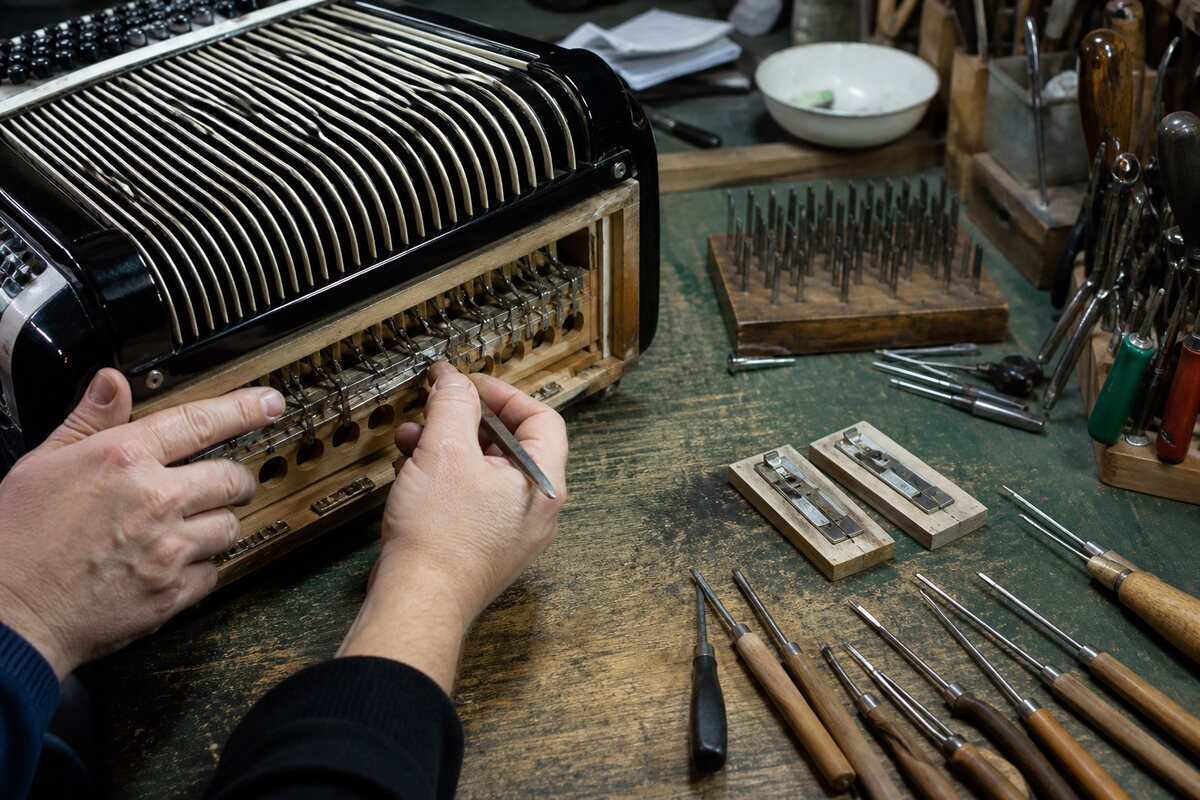
The name Paolo Soprani appears in the Castelfidardo story because the museum identifies 1863 with the first Italian accordion company. For a reader, that date is useful less as a finish line than as a door. It raises the next questions: what kind of instrument was being made, how did the workshop economy change, and which later makers developed their own paths?
Historical labels often compress several things into one sentence: a person, a workshop, a registered company and a regional industry. The Bellows Atlas keeps those categories visible. We can cite the museum for the date and the institutional framing while marking any model-level or family-level detail that needs a separate source.
This is also why the encyclopedia links a maker to a place and a time before it links to a product claim. A reader looking at an old instrument deserves provenance questions, not a confident story manufactured from a familiar name.
Weighing an origin claim is an exercise in evidence, not belief. A dated reed plate, a stamp, a label or a maker’s mark each carries different weight, and the same discipline applies outside the accordion trade. The Bellows Atlas describes how collectors of Paris antiques assess materials, periods and markings, and how market visits train the eye in reading an object before buying. For the 1863 Paolo Soprani story, the useful question is not whether the date is repeated, but which physical object first carried it, and when that object was made.
Why 1863 is an anchor
The 1863 date matters in the museum narrative because it gives readers a firm point for discussing Paolo Soprani and the early Italian company tradition. It does not mean the accordion began in one instant, nor does it describe every instrument made afterward. A timeline anchor is a coordinate, not an explanation of the whole landscape. The atlas keeps that distinction visible so a date can lead to questions about production, labour and changing markets.
How to read an origin claim
Start by identifying what kind of “origin” a source is naming: a person making an instrument, a workshop opening, a company being established, or a later institution choosing a landmark date. Then compare the wording with the museum collection and any maker chronology. Record the source, date and exact object or organisation involved. This small method helps prevent a business milestone from being repeated as a universal invention claim.
What a reader can inspect
For a historical accordion, document the cabinet, keyboard or button layout, bellows construction, grille, register controls and any surviving label. These observations do not prove a Paolo Soprani connection by themselves, but they give an archivist useful material to assess. A photograph should include the whole instrument and close views of marks. Keep original files and note who supplied them, since provenance is often lost when images travel without context.
Where the story becomes uncertain
Workshop histories can compress family names, company structures and regional manufacture into a short institutional paragraph. Later sellers may also attach a famous name to an instrument because it is easier to explain than an incomplete record. The museum is a reliable citation for its own framing; it is not a universal decoder for every serial number or inherited instrument. Any model-level conclusion needs a separate catalogue or specialist source.
A careful conclusion
A strong article can say that the museum uses 1863 as a significant Paolo Soprani and Italian-company reference, while leaving earlier mechanisms and later industrial branches open for study. That is not evasive. It gives students a timeline, collectors a provenance checklist and writers a boundary around what the source supports. The next useful links are the Castelfidardo place file, the maker index and the method page, each answering a different scale of question.
A date with a next question
Treat the 1863 reference as the beginning of a research sequence. Ask what the museum is dating, then ask which objects, companies and later developments belong beside it. If a source supplies a confident phrase but no object or record, retain the phrase as institutional framing and do not add detail from memory. A good timeline grows by attaching one checkable relationship at a time. That is how a landmark date becomes useful to a player, collector or historian without becoming a simplified invention story.
Source note: Museo Internazionale della Fisarmonica. Accessed August 24, 2026.