Place and events • Events & News
Castelfidardo and the international stage
Museum, maker and competition routes make Castelfidardo a practical base for exploring the instrument’s international life.
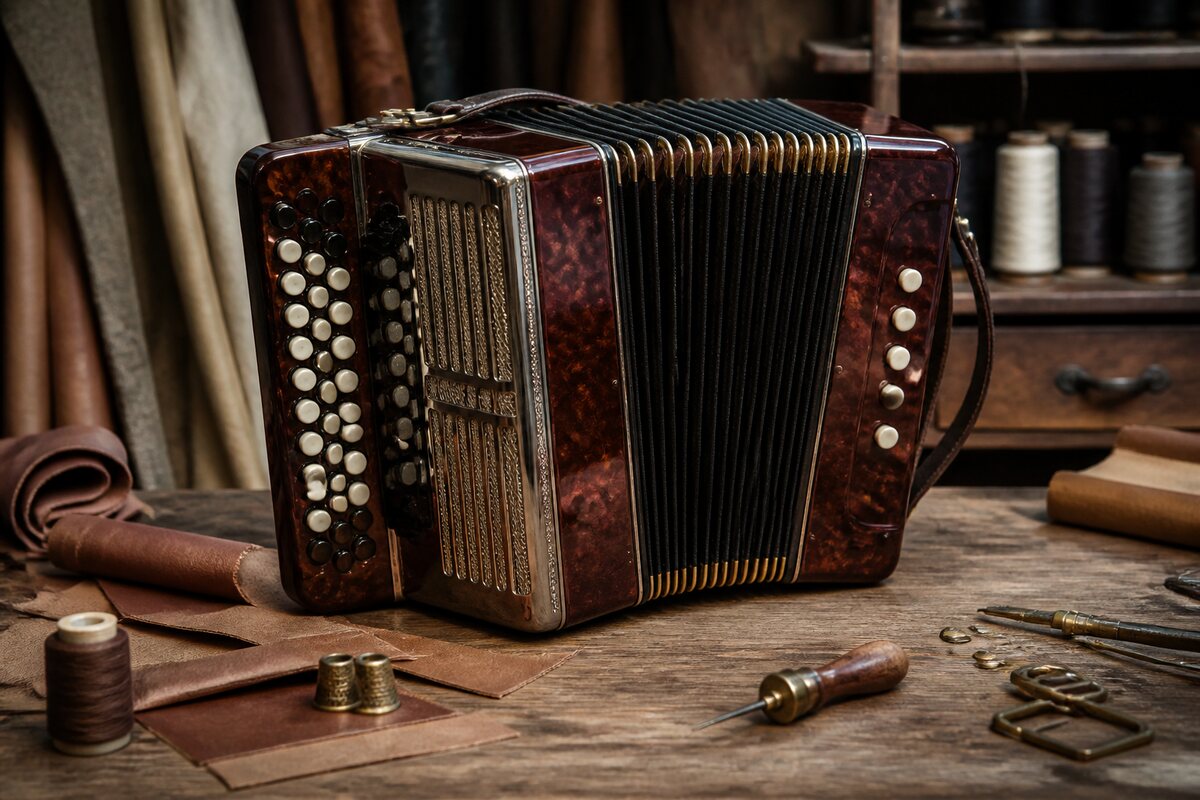
A visit to Castelfidardo can connect several scales of accordion culture: museum objects, maker histories, local memory and the international stage. The museum supplies an institutional collection, while the CIA archive shows how performance communities move across borders. Read those sources together and the town becomes a point of orientation rather than a single tourist claim.
Plan with source discipline. Check opening details on the museum’s official page, verify event dates with organisers and keep a note of which maker or collection a claim comes from. A cultural visit is richer when you know what you are looking at, but it is less reliable when every object is forced into one origin story.
The international stage is not only competition halls. A large part of the instrument’s life abroad has always been civic rather than concert: emigrant bands, church halls and the one public occasion a year at which a town still pays for a squeezebox. In the United States that occasion is usually the Fourth of July, and a county account of the marching-band morning of an American county holiday documents the running order, the pay and the two-hour slot with a precision no discography offers. It is a reminder that the accordion’s international history is written in programmes as often as in catalogues.
The Atlas event file keeps dated information separate from evergreen history so a reader can return without confusing an archive note with a live schedule.
Abroad, the accordion often marks civic occasions rather than concert stages: emigrant bands played for saint’s day processions, town festivals and club anniversaries, and the instrument still opens local parades and community gatherings. The same repertoire of marches, waltzes and hymns serves weddings, funerals and civil ceremonies where no church is involved. Couples planning a non-religious ceremony can read how families take roles, write a script, rehearse transitions and handle the legal side at civic occasions and ceremonies.
One place, several scales
Castelfidardo can connect museum work, maker history, local memory and international performance, but those scales should not be collapsed into one attraction slogan. A museum object answers an object question, a workshop page answers a maker question and a competition archive answers an event question. The value of a visit comes from moving between them carefully. The town is an orientation point, not proof that every accordion story began there.
Plan a source-led visit
Before travelling, check the museum’s official opening information and current event pages. Make a short list of objects, makers or terms you want to investigate, then note which source introduced each one. On site, record labels exactly and distinguish what you saw from what a guide or brochure inferred. Afterward, connect observations to the atlas with a date and source. This keeps memory from replacing the original evidence.
The international layer
Competition and festival pages show how players, teachers, makers and audiences travel beyond one local workshop. They are useful for studying networks, repertoire and public presentation. They do not prove that a town or museum controls the whole international field. Add the host, year, organiser and category to your notes. A performance event becomes historically useful when its context survives alongside its poster or photograph.
Errors in cultural travel writing
A visitor may mistake a museum display for a complete industrial history, repeat a guide’s origin story without checking the label, or describe a future schedule as permanent. Marketing language can also make a regional identity sound uniform. Use official pages for current practical details, institutional pages for collection context and dated notes for events. Keep an archive note distinct from a live schedule.
A concrete route
Start at the museum collection, follow one maker into the manufacturers index, then use a dated event or competition record to find a performance question. Return to the method page to record what each source supports. This route makes Castelfidardo a working research base for players, collectors and cultural travellers, while leaving room for other Italian regions and workshops to tell their own stories.
Make the visit reproducible
A cultural trip becomes useful to other readers when its date, institution, object label and source survive the memory of the day. Keep current opening information separate from historical interpretation, and distinguish a photograph you made from an image supplied by an archive. The resulting note can connect place, maker and performance without turning travel enthusiasm into an unsupported universal claim about Italian accordion history.
Source note: Museum and CIA official pages. Accessed August 24, 2026.